#BuckFiftyADay Since March, 2014

#BuckFiftyADay Since March, 2014

Thursday, February 21, 2013

Finding Landon Donovan

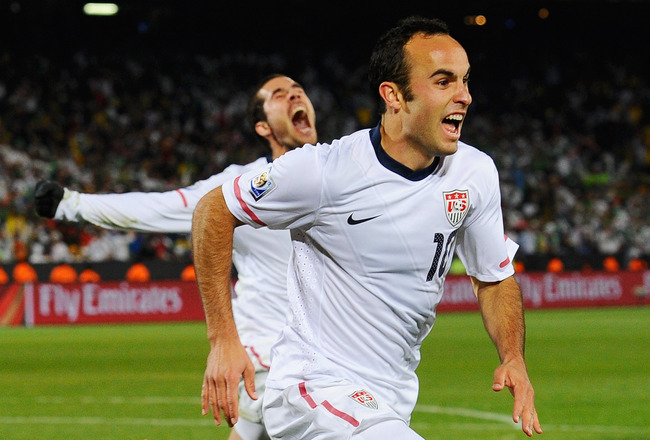
In this moment, the world belonged to Donovan
It's been a long time since I weighed in on anything in American soccer.

You can go back to an old post where I explained it all. When my brother was named coach of the U.S. national team back in 2007, I told my bosses at ESPN The Magazine that I had to leave the beat I'd worked since 1998. I did not feel I could be impartial any longer. I also did not think it would have been right to be poking my nose inside the locker room my brother was trying to command.

When I look at all the conflicts-of-interest in place at the Worldwide Leader, sometimes I wonder if what I did was necessary. I've heard Jeff Van Gundy commenting on his brother's work. Dick Vitale may not be brothers with any of the college basketball coaches he covers, but he has let it be known over a long and profitable career that there are certain guys he won't criticize.

I know what I did was the right thing. But I do wonder if it was necessary.

Which brings me to this blog post, where I will jump back in on American soccer, and offer up my thoughts on Landon Donovan, who, as we all know, is on a sabbatical from soccer.

Back in 2006, before the World Cup in Germany, I wrote about Landon for ESPN The Magazine. He met me at a sushi place in his neighborhood in Southern California and we chatted. When the dinner/interview was over, I could not help but feel I'd just spent time with the most honest, open athlete I had ever met in two decades in the sportswriting business. He had no problems talking about himself -- something that makes many athletes uneasy -- at length, not just talking about his strengths (he said he believed he was one of the best players in the world), but also his weaknesses (he talked about problems he had with his dad). Mostly, he talked about his overall need to be happy.

Bruce Arena, then the national team coach, backed him up, saying, "I like Landon when he's happy. Because that's when he plays his best soccer."

Just to back up a second. When Landon was 16, I met him down in Florida and wrote a short piece about him for The Mag. He was headed to Bayer Leverkusen and being called "The American Michael Owen." He was painfully shy during that interview. He was a kid. So, to see his evolution into manhood that night in So. Cal was a cool moment for a middle-aged sportswriter and dad.

It was easy to see Landon was a really good person.

I wrote my story, turned it in, and got blasted by my boss. Apparently, he'd been reading the wonderful soccer message boards, or had been clued-in to them, I don't know, but he was all over the "Landon is a pussy" theme and wondered why I didn't go hard after that angle. Any American soccer fans knows the "Landon is a pussy theme." He didn't like it in Germany, settled in MLS, tried to go back to Germany and didn't like it all over again. My boss heard about "Landycakes" and was miffed that I did not take him to task for all the accusations being made by anonymous soccer fans.

My defense was that Landon, to that point, had never let the US national team down in any way. He had been brilliant in the 2002 World Cup. He had played very well during qualifying for 2006. I also pointed out that he was an attacking player and attacking players needed to attack. I argued that maybe it was better that our best attacking player play on a team where he is the one who is expected to create chances and score goals and that, perhaps, in Germany he'd be lower on the totem pole and would not have the chance to develop those skills properly. That was my defense.

Then came the '06 World Cup, and things did not go well for Donovan. He did not set up any goals for a U.S. team that lost two games and tied one (impressively vs. Italy, the eventual champions).

In true Donovan form, he shared his inner feelings about his performance, that he didn't play with confidence, that he didn't play as aggressively as he should have.

When I got home from the World Cup, my boss all but jabbed a finger in my chest, pointing out how I'd botched the Donovan piece. At that point, I had no defense. The proof was in his performance.

I guess.

So, let's get this tale back to the present. As you know, Donovan got things right in the 2010. Even in the eyes of his most severe critics, he got things right. He did his usual great things for the LA Galaxy, but also went to Everton on loan and played well. At the World Cup, he rescued the US twice during group play, scoring a critical goal in the come-from-behind draw with Slovenia and the last-gasp winner against Algeria, which got the U.S. into the second round.

He cried on camera and told his soon-to-be-ex-wife he loved her. All vintage Donovan. All part of the package American fans had come to know, to love and hate, since he became a part of the team.

But as the U.S. left South Africa after falling, 2-1, in extra time to Ghana, I could not help but feel that the next US coach, be it my brother or somebody else, was going to have his hands full trying to get another World Cup cycle out of the greatest attacking player our country has ever produced.

I just sensed that all the emotional stuff was taking its toll. Some athletes bear the burden of expectations better than others. I've covered Yankee shortstop Derek Jeter for many years and the thing that's always struck me is how in the most trying times his eyes seem the brightest. It's like Jeter truly believes the big games, the big pressure, the bright spotlight is actually...the most fun.

Is this true? How do I know? Jeter is the anti-Donovan. He rarely lets anyone inside his head. All I go by is the look on his face. I've never seen Jeter look down, or glum, or tired on the biggest stages.

I think we've all seen the wear and tear on Donovan.

And so last night, Donovan spoke to students at USC and he spoke about so many things...and one of the students (@xman818) chronicled it all on Twitter.

Donovan spoke about how soccer is a very small part of who he really is. He spoke about overcoming some of the problems he had with his dad. He spoke about things that broke up his marriage. He spoke about how he cares only about being a good person and is going to Cambodia in 10 days to do something that's not religious, but sounded kind of spiritual.

Every single word out of his mouth was real, and admirable. I hate ever making character judgments on any athletes I write about, but I do believe Landon Donovan is, in fact, a really good person.

Now, how about the soccer part?

Understand, first of all, like Donovan, most soccer players would tell you that the game is not the most important thing in their life. This is not only sound thinking, this is logical and healthy.

Soccer is, after all, just a game.

However, what our soccer-obsessed side needs to keep an eye on is this:

When Donovan puts his soccer shoes back on in late March, will he be able to make the game the most important part of his life. Not the most important part of his life 24 hours a day, 365 days a year. But the most important part of his life when he's actually playing soccer, or practicing soccer, or being a teammate in the locker room. This is called "focus" and it is required of all athletes. Talk to any sports psychologist and he'll talk about looking through the smallest window. Eliminate all the distractions and lock-in on something small. It's a challenge. A freaking huge challenge.

No one should begrudge Landon for being Landon. In fact, at this point, given what Donovan's produced for U.S. Soccer for the last dozen years, we should love and respect the person he is.

My former boss who hammered me for not going with the "Landon is a pussy" theme back before the 2006 World Cup...dude was wrong then and he's even more wrong today. He's proved his toughness.

But if Landon Donovan still has more to give to the US national team once this sabbatical is over, he's going to have to prove it all over again. Not to us, the public, but to his teammates. If he's distracted, they'll notice. If he's not all-in when he returns (and he will return), it won't sit well.

That's my guess.  Just me weighing in, for the first time in a while.


Tuesday, February 5, 2013

I Can't Help Falling (Back) in Love with You...

My Ledger column was a lifesaver
Time to ramble.

Tomorrow marks three weeks since I got laid off by the Star-Ledger. It's cliche to say it, but I truly believe things happen for a reason. Especially this thing.

First, it's got to be said, the Ledger saved me. In May of 2011, knowing my days at ESPN The Magazine were numbered, the Ledger threw me a life line, making me their baseball columnist.

What I learned in my two seasons back on the everyday baseball beat is just how much things changed in the 16 years I was working on features across all sports at ESPN. I have so much respect for the amount of work the daily guys churn out on a day-to-day basis.

Actually, change that.

I have so much respect for the amount of work the daily guys churn out on a minute-to-minute basis. You don't show up at the ballpark at 2:30 anymore just to prep. You show up to begin tweeting, blogging, taking cellphone camera photos. It's all good. It just wasn't for me.

And I know this will get me ridiculed, but the way baseball writers are expected to write about the game has changed so much. Basically, if you can't back up something somebody said, or something you observed, with a telling statistic, you're setting yourself up to get skewered.

There's a whole legion of folks out there now who are in the business of "debunking." I saw this at The Mag. Get a quote from Red Sox batting coach Dave Magadan about Dustin Pedroia's uncanny knack for putting the barrel of the bat on the ball and someone's got a stat to tell you he's only average at that. Heaven forbid you write that someone hits in the clutch.

Personally, I don't buy all of it.

I remember as a young writer sitting down to talk to Bob Boone, then a veteran catcher, about things he observed behind the plate. He didn't care about a guy's average with runners in scoring position. He talked about things he'd seen the day before, or the at bat before, that told him how to attack a hitter, or whether it was a good time to pitch around a guy.

"Writing about leadership is lazy," I was told.
Write the word "intangibles" into a story now and a whole slew of folks will ridicule you. Leadership? I was told this past season I was "lazy" for ever using the word. When I produced a story I'd written on Jason Varitek after the 2004 season, full of observations from teammates about Varitek's influence on the Sox, I was told, "so, he's a hard worker, you can't prove leadership."

Over the last two seasons, I had more than a few heart to heart conversations with Bob Klapisch, an old teammate from the New York Daily News who now writes a baseball column for the Bergen Record and for Fox Sports. I consider Klap among the best baseball writers of all-time (and a future Hall of Famer) because of his understanding for the game's nuances and subtleties, but also for the respect he gets from players, coaches and managers, who can easily see he's more than just a guy who pores through pages of stats.

"The game is an art, not a science, Bradman," Klap would say to me. "We can't forget that."

I'm not stat averse, but I prefer my advanced baseball metrics to be served in charts and graphs rather than sentences and paragraphs. Stories driven by stats remind me of the reading comprehension segment of the SAT, where I always felt the author's sole mission was to bore me to death.

 During my three weeks out of work, I've found myself searching the SI Vault for stories written by Peter Gammons, Steve Wulf and Tom Verducci. Love stories, if you will. For these were the stories that made me love the game of baseball even more.

My Rawlings XPG3 here was passed on to a Gold Glover
I remember when the leadership at ESPN The Mag started throwing the word "wonk" around. As in, "How about we do a more 'wonkish' take on this..." I had to look it up in the Urban Dictionary. (1) Noun - An expert in a field, typically someone who is fairly young and very intelligent. 

I knew I was no wonk. If there's a market for wonkish debunking, that's fine. I'm not going to be a regular consumer.

Tyler trusts the pocket of his Wilson A2000
I just hope there's still a market for baseball romance. Because that's what I read. I still believe in "clutch" and "intangible" as much as I still believe in batting average, RBI and...gasp...wins.

Which brings me back to the "everything happens for a reason" cliche.

In the aftermath of my layoff, my friend Paul Cunningham of Leather Head Sports reached out to me. Paul grew up in Cooperstown, N.Y, and is a hopeless baseball romantic, like me. Paul's passion is for leather-made sporting goods. Our friendship evolved over a mutual fascination with baseball gloves.

I broke in a few gloves for Beau, my defensive wizard
Both of us were "sorta" college baseball players. Paul played at Drew University. I played on the JV team at North Carolina. Paul told me he always played under the (wrong) assumption that he was the perfect glove away from getting drafted. I always had the best gloves, thanks to my brother, and earned my varsity respect at UNC for my ability to break-in gloves. My absolute best work occurred when I helped a future Gold Glove winner in Walt Weiss by donating my Rawlings XPG3 to him when we were both freshman and he was having backhand issues with his Wilson A2000.

It doesn't get any more romantic in sports than a baseball glove, does it? The smell of the leather. The way the perfect glove earns your undying trust. Just put it out there and the ball will stick.

Paul and I are going to launch a line of baseball gloves under his Leather Head brand. It's going to be a lot of hard work, fueled by passion. Fueled by baseball romance. There's going to be trial and error. But we're going to make some incredibly sweet gloves, and I'm going to be calling on so many people who helped me learn the game over the last 40-plus years. Old teammates, coaches, dads who've sat in the stands the last decade with me watching our sons play ball.

Now, I'm sure you could throw a stat sheet at me that will tell me we have no chance to succeed. Give it to me and I'll throw it right in the trash. I'm going to believe baseball is an art, not a science.

And I don't think there's a wonk out there who can teach me a thing about baseball gloves, about what makes a good pocket or what makes a web double play friendly.


Paul and I know this stuff.

I'm not going to stop writing (as you can see above, I still like to tap on a keyboard, and I'm going to look to dive back into writing about soccer in the near future), but I'm going to try something new, with something I love. And I'm going to lean hard on "things happen for a reason."

And trust my intangibles.


Also, check out...

The Wall Street Journal thinks Leather Head may have invented "The Perfect Football"

How to make a Leather Head Football by Paul Cunningham


Friday, February 1, 2013

First a brother

Portraits of some of the Al-Ahly fans who were killed in Port Said
One year ago today, in the city of Port Said, Egypt, 74 young men were killed in a riot following a soccer match...

I will write this post in sentences rather than paragraphs as a way of forcing myself not to dive too deep into the subject matter, so forgive me if I jump around a bit.

My level of understanding is lacking, even though I've done a lot of reading (including this powerful piece Murder in Port Said by Adam Moustafa)

I do know this was not the typical "soccer riot" that gets played on American news channels.

It had little if anything to do with sport.

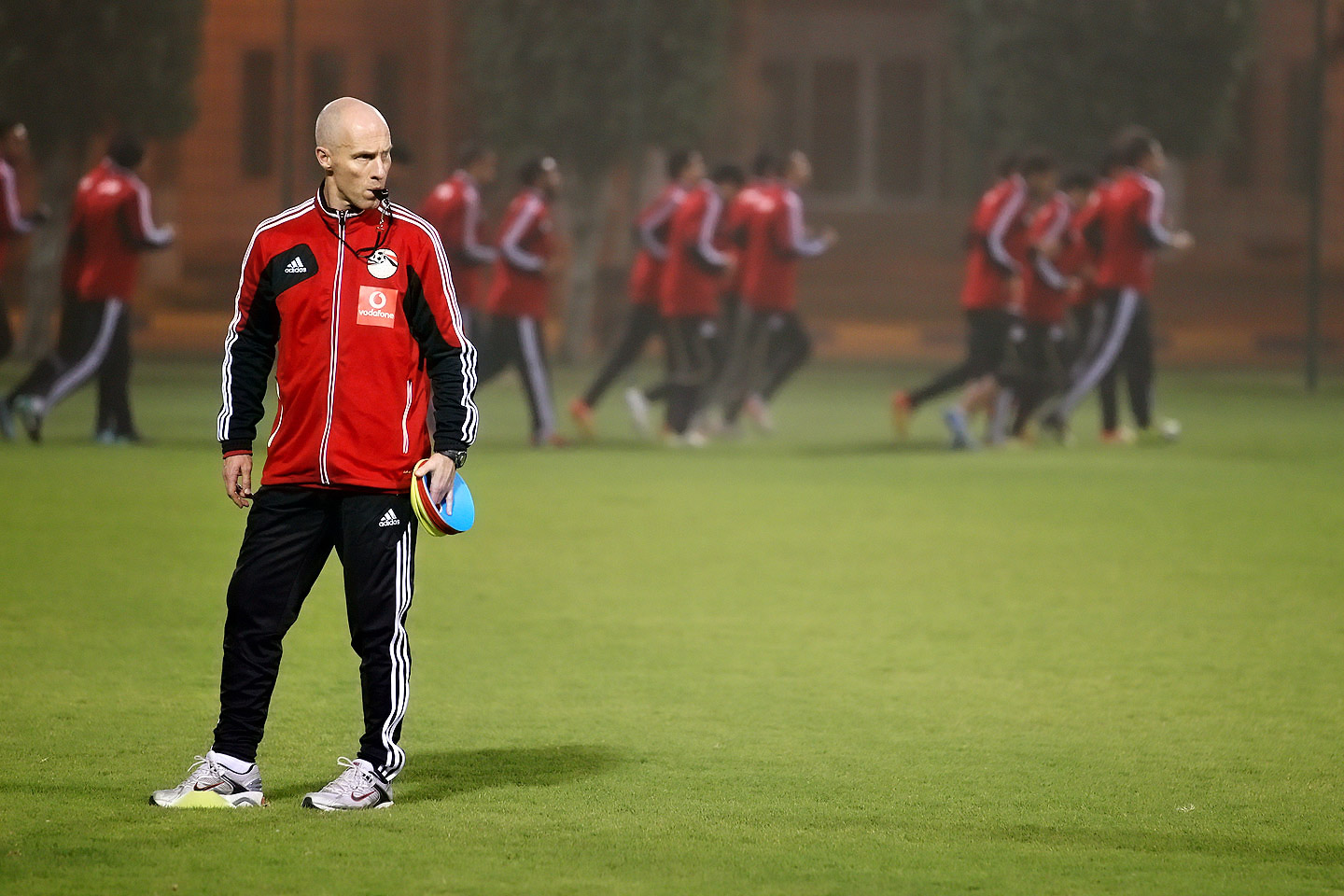
When I saw the footage on television, and heard about he death toll, obviously, my thoughts immediately turned to my brother Bob, who is the coach of Egypt's national team.

One of the teams playing in Port Said was Al-Ahly.

Many of Egypt's national team players play for Ahly.

I figured there was a good chance that Bob and his staff were in Port Said to evaluate players.

Thankfully, they were not.

Still, so much changed for my brother on that day.

I'm not even talking about the things that affected Bob's ability to coach Egypt and fulfill his mission to get the Pharaohs to the World Cup for the first time since 1990.

I'm talking about the way his life changed.

Throughout my life, Bob (I call him "Rob") has been my counselor, in good times and bad.

Now, it was like he had become a brother to many people.
This is where my brother is happiest, on the field with his team

A brother to his players and his staff.

A brother to the family members who lost loved ones.

He was just being himself.

This I know.

A year later, so much has happened in Egypt.

Very little has happened on the soccer field.

His decision to go to Egypt was all about trying to become a better coach.

He wanted the the challenge of learning about Egypt's players.

He looked forward to making them a better team.

These goals haven't changed, but his course has been altered.

He could have left.

He stayed.

He's not making excuses.

The most powerful thing I've heard him say, about coaching Egypt in the aftermath of Port Said was, "What we've said to the team in the last few months, on different occasions, is just keep in mind, when we get on the field, the ref's going to blow the whistle and there's going to be 90 minutes. And during that 90 minutes, nothing that's gone on during this whole period matters. People can speculate. People can make excuses. People can throw blame. But during that 90 minutes, it's on us."

Really, it's on him.

The soccer part, anyway.

It will end in victory.

Or defeat.

Like all games.

There will be jubilation or sorrow.

There will be praise or criticism.

Hopefully, regardless of the results on the field, the people of Egypt, including those who lost loved ones one year ago today, will feel like they gained a brother.


Recommended reading:

Wayne Drehs of ESPN.com, on Egyptian icon Mohamed Aboutrika

And Drehs, again, on Soccer in the Storm

Aaron Ross of Rolling Stone on The Quiet American

James Montague for for the New York Times on Egypt's first World Cup Qualifier  

And another documentary in the making.

We the Pharaohs by former Princeton player Jeffrey Plunkett

Monday, January 28, 2013

Textbook Sportswriting? Someone thought so

I remember writing about a young Derek Jeter
Looking for a job as a writer these days is interesting. I'm old enough to remember keeping a "clip file" of what I thought were my best stories. It was a black binder with a lot of those clear plastic sleeves. From 1989-1995, when I'd write a story for Sports Illustrated or the Daily News that I thought was a "keeper" I'd diligently clip it and slip it into one of those sleeves.

When I applied for jobs, I'd remove what I thought were my two or three best stories, make copies at a copy story, and mail them along with a resume to the prospective employer.

These days, with internet archives, the process is quite different. A writer now can usually just cut and paste the links to his best work into an email. If you look over to the left side of this blog site, you'll see that I've chronicled a sampling of what I think are some of my best stories from 13 years at ESPN The Magazine. So, these days, I'm sending along two or three links, but also let folks know if they want to see more, they can access a bunch of stories on Jeff-Bradley.com.

Of course, there can be glitches. For example, one of the first stories I ever wrote for The Mag was a story on a young Derek Jeter. It was always one of my favorite pieces, but the Mag's on-line archives do not go back as far as 1998 and I never clipped and filed that one. It's like it doesn't exist.

I remember writing the story so well because the assignment came out of nowhere. I was in a pub in Manhattan watching some soccer -- cool lunch break -- with some colleagues, including Steve Rushin from Sports Illustrated, when my Flip Phone rang.

"We want you to write a feature on Derek Jeter," said my editor Steve Wulf. "For the next issue."

I don't expect any newspapermen to feel sorry for me, but in the Magazine world, this is considered writing on deadline. I had to book a flight to Detroit, where the Yankees were playing, immediately and have a feature on Jeter turned in about 48 hours later.

I remember pulling a college-style all-nighter in the Dearborn Inn to get the story done in time. I remember pacing around when it didn't seem the words were coming together. And, ultimately, remember waiting for word from the staff, and expecting the worst. And I remember Wulf (not only my editor, by my friend and mentor) telling me "I'm not changing a word." There's no higher praise a writer can get from an editor. And it doesn't happen very often.

But, dammit, how was I ever going to find the story? I rifled through a bunch of old copies of the Mag that I keep in bins in my basement. No luck. As a last resort, I figured I could get in touch with someone at the Mag and if they could hunt it down for me. But there was one last thing to try.

I remembered a few of the words to the lead. I remembered I led with a story about the scout who discovered and signed Jeter. So I started to type some words into google.

Someone liked my lead, I guess
I typed, "It's a life of mid-size cars..."

Bam! It came up in, of all places, a text book on sportswriting, called "Sportswriting: The Lively Game." In the chapter on writing a profile. The author of the text book, Conrad C. Fink, writes "Above all, the profile gives you the opportunity to write your way into the sports pages - and readers' hearts. Note this colorful, engaging writing:"

It's a life of mid-size cars, mid-level hotels and drive-thru dinners just off the interstate

Your best friends are talk radio and the USA Today box scores. Your worst enemies are a full bladder and a sign that reads "Next Service Area 56 Miles." You work a territory, usually three or four states, and you have to be prepared for all of nature's elements. You learn quickly never to leave home without long johns, a rain slicker and sunscreen.

The life of an area scout for a major league baseball baseball team is a lonely one. High school game one day. College game the next. Juco game. American Legion game. Babe Ruth game. Pull up your folding lawn chair, point your radar gun, click your stop watch. Hundreds of games. Thousands of players.

Then it happens. As quickly as a coach can spank a fungo across a choppy infield in Flint, Mich., you remember why you got into this business. The ball takes a high bounce, then a low one. It begins to roll then pops up again like bacon grease off a frying pan. A tall, reed-thin shortstop somehow calms the ball. He glides in, reaches forward to glove it, makes the transfer and then fires a smooth, firm throw to first. You are left breathless. The kid is a high school sophomore. 

"I see an electric body," Yankee scout Dick Groch recalls. "Thin, but with lithe, sinewy muscle. Classic infielder's body type.  Fluid and graceful." At this moment the scout gathers himself. Time to find out more about this boy, beginning with the basics.

Jeff Bradley, ESPN Magazine

 I still don't know how to get the whole clip, but I don't really care anymore.

Friday, January 25, 2013

The Weirdness...me covering baseball for a living

Scott (Danny Tartabull and Spike Owen) distracted me.
The truth is, it's always been a weird profession for me. Writing about baseball, that is.

There was a conflict of sorts from the beginning, with my brother Scott, who was playing for the Mariners when I went to work for Sports Illustrated in 1989.

Now, understand, I was really nothing more than Peter Gammons' personal fact-checker during my years at SI, but I'd be lying if I said I didn't always have one eye on Scott and the M's. There was no internet back then, but there was the AP wire, which I could access from the immense computer in my tiny office on 50th and 6th.

I can confess now (sorry Jane "Bambi" Wulf, SI Chief of Reporters), that I took a few too many breaks to check out what was going on with the Mariners.

There was also an incredible library in the SI office, with newspapers from all over the country, including Seattle. If ever anyone wanted to sneak a peak at the Seattle Times or the Post-Intelligencer they knew where those papers could be found. I could check-in to see what the beat writers had to say about Dave Valle getting most of the playing time over my brother.

See what I mean about conflicted?

When I went to the Daily News in 1992 to cover the Yankees, Scott was still with Seattle and a lot of people asked me, "How are you going to handle covering your brother?" My response was (BS) that I'd just cover him like any other player. That I'd stick to the facts and remain unbiased (BS).

I never got to cover one of Scott's games. About a week into my first year on the Yankee beat, my brother was released, which made me even more conflicted. I went to Buck Showalter, the manager of the Yankees and a former minor league teammate of Scott's, and Gene Michael, the general manager who always said nice things about my brother and, basically, begged them to sign Scott.

Yeah, not the most professional behavior there.

He ended up playing briefly with the Reds in 1992, getting a handful of at bats off the bench for Lou Piniella, before getting shipped back to the minors, never to play another game in the bigs.

I do have this one memory of Scott's time with the Reds while I was on the Yankee beat. Again, this is way before the internet, and some of the ballparks would run an out-of-town scroll on their message boards during games. I glanced up from my word processor (yeah, Radio Shack) and saw something like: BRADLEY, PH RBI SINGLE... Scott's last Major League hit. Off Orel Hershiser.

The next spring, Scott was in camp with the Mets, under Jeff Torborg, and looked for a couple of weeks like he had a chance to make the club. But as it got closer to Opening Day, his ABs dwindled and we all knew release day was coming.

Not that it would have been a big story for the Mets writers if my brother ripped GM Joe McIlvaine (it would have sounded stupid), but I called him and told him, if asked by the writers how he feels about getting cut, the best thing he can do is be grateful for the career he's had.

"You can be one of those guys who's pissed off that the last couple of teams didn't like you, and that it may have cost you 3-5 more years in the bigs," I said. "Or you can remember Dick Williams, the one manager who believed in you, and thank him for helping you become a big leaguer."

Scripting a player's quotes is not exactly part of a writer's job. But I do remember getting a call from Port St. Lucie from some of the Mets writers, telling me what a class act my brother was...

I'm sure he'd have handled it the same way, even without my advice.


Thursday, January 24, 2013

What kind of baseball geek am I?


I spent way too much time talking gloves with Gags
It was the worst tabloid baseball story ever.

My friend Joel Sherman, the brilliant baseball columnist at the New York Post, has reminded me of this more than a few times though the years. It was 1992, my first year at the Daily News, and I found myself spending a lot of time around the locker of Yankee infielder Mike Gallego. I was fascinated with the number of baseball gloves Gallego kept in his locker. Probably about 20 gloves.

Now, Gallego and I had some history. One of my best friends in college was Walt Weiss, who played with Gags in Oakland. Before I worked at the News, before I was really in the business, it was pretty normal for me to go and watch Walt play and hang out with members of the A's. I was also in Seattle on a few occasions when my brother Scott's Mariners were hosting the A's, and a large group of us would go out for something to eat after games. So, anyway, I liked chatting with Gallego.

Eventually,  I wrote a feature on Gallego's gloves. It probably had a headline like "Glove Affair" or "Glove Story," but I can't really remember.

Sherman -- and Jon Heyman from Newsday, Jack Curry from the Times, Moss Klein from the Ledger, Don Burke from the Record, Tom Pedulla from Gannett and Jack O'Connell from the Hartfourd Courant -- had been beating me, the rookie on the beat, like a drum on real news stories. So, a story on the scrappy, little infielders glove collection, was pretty laughable.

To this day, when I see Joel in the clubhouse, he's still likely to say, "Good time to revisit the Gallego Glove Story." It's all in good fun, and totally fair. It was 100 percent not a tabloid baseball story.

I didn't really care,  partly because I was a different kind of baseball geek than most of the baseball writers. I'd grown up in the same house as a big league player, shagging flies during his BP, working on my own swing with him in our basement, where we set up a tee and net. I'd had my own brief run at North Carolina, where I was a practice player, taking groundballs alongside Weiss. Not saying other writers could not play ball. Bob Klapisch was a pitcher at Columbia University and still throws in the wood bat leagues in North Jersey (not the over 40 leagues), and John Harper of the News and Curry have also clearly worn a cup.

Just saying, my passion for the game did not really come from digging into statistical minutiae. That was one thing.  Another was, having seen just how hard it was for Scott -- an All-American at North Carolina and a hitter good enough to win a Triple-A batting title -- to play regularly in the big leagues, I was simply not the type of writer who was going to trash players in print. It was probably my fatal flaw as a baseball writer from the beginning. I had way too much respect for how hard baseball is.

At Carolina, I'd faced guys like Scott Bankhead in intrasquad games. I knew what a 94 mile per hour fastball looked like (blurry) and what it was like to try and hit a tight slider (impossible).

Yet, at the same time, I was fascinated with the game. I was romantic about it. I loved watching guys in the cage, eavesdropping on what the hitting coach was telling them. I would get mesmerized watching middle infielders and their footwork on the doubleplay, sometimes even catching myself, notebook in hand, mimicking them. I admit, I was a wannabe player.

But, back to the gloves. We, the New York writers, were getting ready for our annual media game with Boston. Surely breaking some kind of BBWAA code, I asked Gallego if I could borrow a pair of his spikes. He said sure, and said, "Keep them for next year's game."

And then Gags asked if he could see my glove. I flipped it to him. It was a Rawlings custom glove my brother had passed on to me when it still looked like I might become a decent player.

"This is nice," Gallego said. "I want it."

I laughed. Yeah, right, the guy with 20 gloves in his locker wants my glove.

There it is, the glove I got in the trade with Gallego.
"No, really, I've got to have this glove," Gallego said. "Take any glove you want out of my locker and we'll trade. I won't take no for an answer. Pick one out."

For some reason, I remember thinking, "Maybe one day I'll have a son and he'll need a small-ish glove to start with." So, I found the smallest glove in his locker, a Mizuno, and made the trade.

During pregame, as I milled around the field, I noticed Gallego using my glove as he took fungoes. At that point, it mattered very little to me that Joel or anyone had teased me about the worst tabloid baseball story ever written. A member of the Yankees was using my glove. A glove he had to have.

I went to the press box that night on a bit of a high. But when the game started, I noticed Gallego was not using my glove. After the game, I said, "What? You didn't like it?"

"No, I love it," Gallego said. "But it's not like it's going to replace my gamer."

I asked if I could have it back.

"No way," Gallego said. "The trade is official."


So, yeah, it was the worst tabloid baseball story ever, but for me it remains memorable. I never did get the hang of being the hard-nosed, news-breaking baseball writer. I'm okay with that.

I'm more than comfortable being my own kind of baseball geek.


Wednesday, January 23, 2013

How about Thursday? I'm just not sure

Remember when Christopher took all the Ledgers out of the box?
In my final semester of college in 1986, I was offered a full-time job as a news clerk with the Associated Press in Raleigh.

I told the bureau chief I was going to accept the offer. And then I asked him when he would want me to start. I still had about two months left before graduation.

My thinking was that maybe I'd take a month off after college to travel, have some fun, blow off steam...

"How about Thursday?" was the answer. And so it began, my career in journalism. Working nights in the A.P. bureau in Raleigh, typing in the data for the North Carolina hog markets, taking dictation from Division III Sports Information Directors, changing ribbons on what we called "printers."

Other duties included making runs to Char-Grill for the staff, filing papers, making sure the coffee was fresh and hot.

Basically, I learned to take a punch.

Fast forward 27 years to last Wednesday morning around 9 a.m. My home phone rings and the caller ID says "Newark." On the other end of the line is my boss, Kevin Whitmer, the editor of the Star-Ledger. I don't want to misquote Kevin here, but he said something like, "This is not the type of phone call I enjoy making...you need to come to Human Resources tonight at 5:45 and there's a story on NJ.com that will shed some light..."

"I'm losing my job?" I asked.

 "Legally, I'm not allowed to tell you anything more," Kevin said. "Read NJ.com."

And then, I addressed my boss in a way I'd never address a boss. "See ya later, brother," I said.

I read the NJ.com story about 34 layoffs at the Star-Ledger, including 18 in the newsroom.

I texted my wife, a schoolteacher and typed, "I just got laid off."

Around 5:30 p.m. that night, after I was told "legally" that I wasn't supposed to be in the newsroom, I was ushered into the HR office where I got my packet. Three weeks severance plus the two of weeks vacation I'd never used.

And just like that, for the first time since I walked through the doors of the A.P. office in Raleigh, I was an unemployed American.

 A TALENT ISSUE

It's not the first time I've lost a job. I accepted the baseball columnist job at the Ledger because in 2011, ESPN The Magazine did not pick up my contract after I'd worked for them for 13 years, 10 months. They had offered me a new three-year deal after the 2010 World Cup, but pulled it off the table about 10 days later and changed it to a one-year contract with a bleak outlook for the future.

When I asked if I could discuss a reduced contract with more security in terms of years, I was told, "It's not really a money issue. It's a talent issue."

What do you say to that?

I said nothing, partly because I knew I was about to cry.

I loved writing at the Magazine so much because I was so invested in the product. John Papanek, the first Editor in Chief of The Mag, had hired me in December of 1997, three months before it was launched. I started as an editor and slowly moved into a position as a senior writer. It was the job I had always dreamed of having, dating back to college. And now it was gone.

"A talent issue," was the reason. So funny, because I'd never considered myself "talented." One of the things I loved about The Mag was that, for years, the people in charge seemed to like me even though I wasn't talented. I was a sports writer. I liked writing about sports. I didn't quote French authors or feel the need to use a thesaurus (or send my readers to dictionary.com).

That's why The Mag was heaven for me, a self-described hack.

Now what was I going to do?

Thankfully, the Ledger, the paper I grew up reading, was there for me. Even though it had been 16 years since I'd written for a daily, they hired me to be their baseball columnist.

The day of my first column, with my mug shot on Page One, I joked to people that, like Christopher Moltisanti on the Sopranos, I drove to a box on Bloomfield Ave., put four quarters in the slot and took every copy. It wasn't true, but that's how good it felt.

I cannot pretend that I was a good or even a mediocre columnist for the Ledger. I was thoroughly challenged by the deadlines.

I often questioned myself. I tried my best, but I'd be lying if I said the pressure of producing day after day didn't rattle me. It did.

And then came last August, when our skillful, hard-working Yankee beat writer Marc Carig was offered a great job at Newsday.  

MARCHING TO THE BEAT

The Ledger's financial issues were very public at that point, so I knew what was going to happen, and it did. I was told "another writer is not walking through the door" and so I was no longer a columnist, I was the Yankee beat writer.

I was not happy. I have two teenage sons who like having a dad to make them breakfast in the morning. I have a wife who works full-time.

When I was the columnist, I'd often walk through the door after 2 a.m. after covering a game in the Bronx or Flushing. But at least I'd be home. A baseball beat writer spends about 150-170 nights per year in a hotel room between the months of February and October.

Had the Ledger been looking for a Yankee beat writer when I was on my way out at ESPN The Magazine, I would not have even filled out an application. I wouldn't have done that to my family.

But now, I knew I had no choice but to accept the job-switch because the alternative was to be unemployed. So I went on the beat and, really, the rest is a blur.

 I don't remember much of what I wrote in August, September and October. I just know I wrote a lot. I didn't miss any deadlines. That's the good thing.

But when it comes to remembering anything I typed, I can come up with only one lede that stayed with me.

Here it is. From the Yankees-A's game on September 22.  

NEW YORK — In the five hours and 43 minutes it took to play the game, it seemed day turned into night, summer turned into fall, and 36 Yankees turned into one.

What's funny is I didn't realize that summer officially did turn into fall that day.

It was pure luck.

Fittingly, it wasn't talent that came up with those words. It was luck.
  
BETTER TO BE LUCKY

And I've been lucky. Lucky to go nearly three decades without ever having to beg for work. Lucky to have done exactly what I set out to do when I enrolled in Journalism School as a college junior back in the Fall of 1984. Lucky to have worked at Sports Illustrated, The New York Daily News, ESPN The Magazine and the Star-Ledger.

And lucky to have learned how to take a punch at the A.P.

 As I walked into the streets of Newark, packet in hand, I did not feel any anger or sadness. I'm not sure what I felt, probably because I'd never felt unemployment before.

 I realize I'm not alone. So many friends from my past have reached out and told me how they handled unemployment. By taking on projects around the house. By committing to a crazy workout routine. By cooking dinner for the family every night.

 I've also heard from some talented (and I don't just throw that word around) writers who are also looking for work. It's so humbling. These are hard times in the only business I've ever known.

It's too early to say what I'm going to do. It's only been a week.

Today, if someone were to say, "How about Thursday?" I don't know what I'd do.